Why are there so many grades of optical glass? Discover core parameters (refractive index, Abbe number), glass families, key differences between N-BK7/N-SF11/LASF9, and practical tips for optical design, engineering, and material selection.
I. Have You Ever Had This Confusion?
You open an optical design quotation sheet and see the "Material" column densely filled with:
N-BK7, H-K9L, N-SF11, LASF9, H-ZF52A……
A colleague casually remarks: "These glasses have similar performance, but their prices differ by dozens of times."
You wonder: Aren’t they all glass? Transparent, light-transmitting—why so many grades?
If you’ve ever asked this question—congratulations. Today you’ll get an answer that eliminates this confusion forever.
II. An Analogy That Makes Everything Clear
Let’s start with a simple experiment.
Shine a flashlight through a glass of clear water: the light travels straight. Add sugar to the water, and the light bends more. Add more sugar, and the bending becomes even greater.
The "sugar" in optical glass is various metal oxides and rare earth elements.
Lead, barium, lanthanum, titanium, niobium… Optical glass manufacturers melt SiO₂ (silica) and add these "ingredients" in different proportions—like mixing a cocktail. The result is glasses with varying refractive indices and dispersion characteristics—i.e., "different grades."
But why so much complexity? Why not use just one type?
III. Understand Two Core Parameters First
3.1 Refractive Index (n): How Much Light Slows Down in Glass
The physical meaning of refractive index: the ratio of the speed of light in a vacuum to its speed in the medium.
- Air: n ≈ 1.0003
- Common glass (N-BK7): n ≈ 1.517
- High-index glass: n > 2.0
Higher refractive index → smaller curvature needed to bend light.
This is critical for compact optical systems. High-n glass allows thinner, flatter lenses, reducing aberration and weight.
Practical Example: Smartphone lenses fit 5 elements into a 6 mm thickness—thanks largely to high-refractive-index glass (and plastic).
3.2 Abbe Number (V): The "Dispersion Personality" of Glass
This is the most important concept in this article.
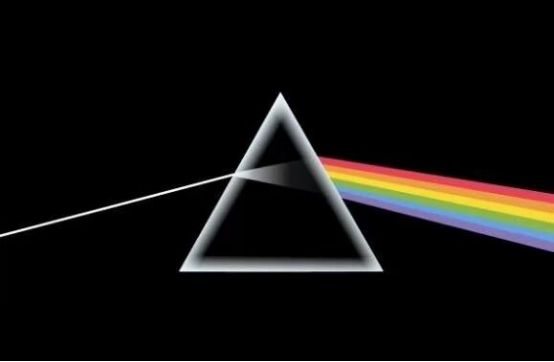
White light is not a single color but a mix of wavelengths. Glass refracts shorter wavelengths (blue) more than longer ones (red)—so white light splits into colors. This is dispersion.
The Abbe number (V, or dispersion coefficient) quantifies this "color-splitting tendency":
Where:
-
nd: Refractive index for yellow-green light (587.56 nm)
-
nF: Refractive index for blue light (486.13 nm)
-
nC: Refractive index for red light (656.27 nm)
-
Higher V → lower dispersion (more "stable")
-
Lower V → higher dispersion (more "active")
| Typical Range |
Description |
Representative Grade |
| V > 70 |
Ultra-low dispersion |
N-FK51, CaF₂ |
| 50–70 |
Low dispersion (Crown) |
N-BK7 (V=64.2) |
| 30–50 |
Medium dispersion |
N-BAK1 |
| V < 30 |
High dispersion (Flint) |
N-SF11 (V=25.7) |
IV. Why So Many "Ingredients"? The Art of Achromatism
With n and V understood, we can now see why optical systems need multiple glass types.
4.1 Chromatic Aberration: A Problem No Single Lens Can Solve
A simple convex lens focuses blue light closer than red light. The image has color fringing at the edges—this is axial chromatic aberration.
To eliminate this, 18th-century optician John Dollond discovered a brilliant combination:
One low-dispersion (high-V) crown glass + one high-dispersion (low-V) flint glass, cemented together, brings red and blue light to the same focus.
This is the Achromatic Doublet (1758), still a building block of many optical designs.
Achromatic condition:

4.2 Secondary Spectrum: Demanding Requirements Drive More Grades
An achromatic doublet aligns two wavelengths perfectly—but a third wavelength remains offset. This residual error is secondary spectrum.
For high-performance systems (e.g., apochromatic lenses correcting three+ wavelengths), special glasses with abnormal dispersion are needed—outside the "normal line" of standard crown/flint glass.
V. Common Glass Families & Their Compositions
| Family |
Composition |
n Range |
V Range |
Application |
| BK (Borosilicate Crown) |
SiO₂ + B₂O₃ |
1.48–1.53 |
60–70 |
General optics, protective windows |
| SK (Dense Crown) |
SiO₂ + BaO + B₂O₃ |
1.58–1.63 |
56–60 |
Camera lenses |
| F/SF (Flint) |
SiO₂ + PbO (traditional) / SiO₂ + TiO₂ (lead-free) |
1.60–1.90 |
20–40 |
Achromatic negative elements |
| LAK/LAF (Lanthanum Crown/Flint) |
La₂O₃-based |
1.65–1.80 |
40–55 |
High-performance zoom systems |
| LASF (Dense Lanthanum Flint) |
La₂O₃ + Nb₂O₅ + ZrO₂ |
1.85–2.05 |
20–38 |
Ultra-compact wide-angle lenses |
| FK/PK (Fluor Crown) |
SiO₂ + CaF₂/BaF₂ |
1.45–1.50 |
70–90 |
Secondary spectrum correction, UV transmission |
In short:
- Rare earths (La, Nb, Gd) → high n, high cost
- Fluorides → low dispersion, hard to process
- Lead/titanium → high dispersion, for achromatism
Every grade is a trade-off between performance and manufacturability.
VI. Three Practical Questions Engineers Care About
Q1: Is N-BK7 sufficient for common projects?
A: Yes, most of the time.
N-BK7 is the most widely used optical glass globally—excellent homogeneity, low cost, easy machining (n=1.517, V=64.2). Great value for money.
Use BK7 if chromatic aberration is non-critical (e.g., collimation systems, monochromatic applications).
Q2: Differences between domestic (CDGM H-series) vs. Schott/OHARA?
Core grades have matching performance (n/V deviations typically in the 3rd decimal place). Key differences:
- Homogeneity: High-end astronomical/laser systems require H4/H5 grades.
- Bubbles & inclusions: CDGM now matches international standards for premium products.
- Special grade coverage: Schott/OHARA still lead in extreme rare-earth glasses.
Q3: Why is the refractive index temperature coefficient (dn/dT) sometimes more important than n itself?
In high-power lasers, thermal imagers, outdoor precision instruments, temperature changes cause refractive index drift → focus shift (thermal defocus).
Glasses with negative dn/dT (e.g., some phosphates) paired with positive dn/dT glasses enable athermalization—stable focus over wide temperature ranges.
This is another reason for diverse glass grades.
VII. An Overlooked Detail: Refractive Index Homogeneity
Within a single glass blank, n varies slightly from center to edge.
This difference is Refractive Index Homogeneity (Δn, unit: ppm).
| Grade |
Δn (ppm) |
Typical Application |
| H1 |
±50 |
General optics |
| H2 |
±20 |
Photography, industrial |
| H3 |
±5 |
Precision instruments |
| H4 |
±2 |
Astronomy, lasers |
| H5 |
±0.5 |
Top-tier interferometers |
Example: Expensive LASF9 with H1 homogeneity may underperform H4-grade N-BK7 in wavefront quality. A common beginner mistake.
VIII. Summary: Grades = "Recipes for Light-Matter Interaction"
Back to the original question: Why so many optical glass grades?
The answer is simple:
- Refractive index → bending power → meets focal length/size needs.
- Abbe number → dispersion behavior → achromatism requires mixed V values.
- Abnormal dispersion → corrects secondary spectrum.
- dn/dT → athermal design for temperature stability.
- Homogeneity, transmission, chemical stability → extreme application demands.
Every grade is an optimal balance of performance, manufacturability, and cost—crafted by optical engineers.
Behind those dense material codes lies centuries of human exploration to answer one question: How to control light with precision?

