Why do high-end infrared lenses cost so much? Understand F-number, aspheric surfaces, AR/DLC coatings and athermalization — the four technologies that drive IR lens performance and price.
An infrared lens is not expensive simply because it focuses infrared light. Its price is decided by four core technologies — F-number, aspheric surfaces, infrared coatings and athermalization design. Each one raises imaging performance, and each one raises the difficulty of design, materials and manufacturing.
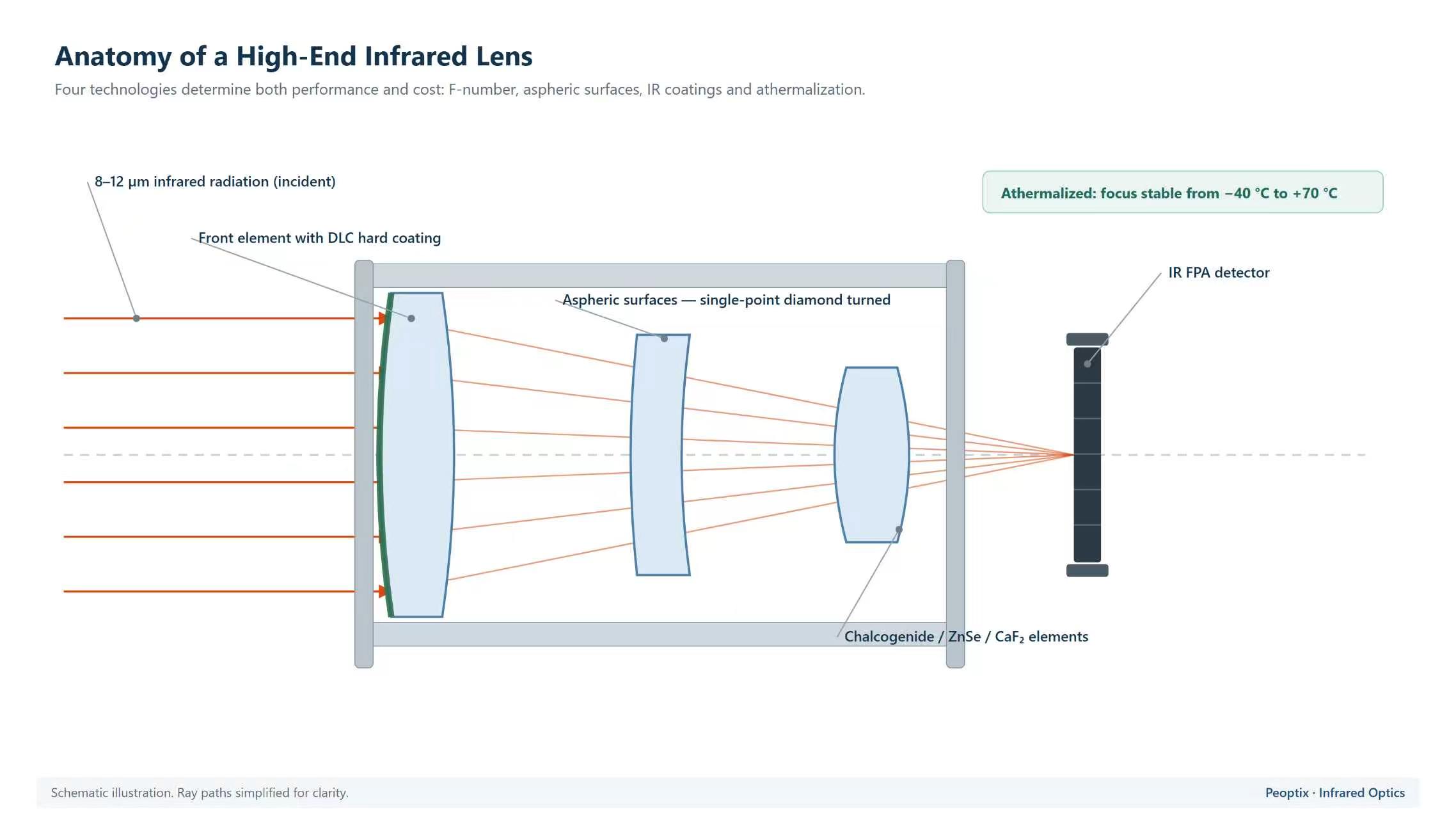
Figure 1. Anatomy of a high-end infrared lens: aspheric IR elements, DLC-coated front surface and athermalized focus (schematic).
1. F-Number: Smaller Means More Light — and More Difficulty
The F-number is the focal length divided by the effective aperture diameter. A smaller F-number opens a larger aperture, so the detector receives more infrared radiation: the signal is stronger, noise is easier to suppress, and NETD improves — especially for low-temperature-difference targets. The price follows the physics: more material, harder aberration correction, tighter alignment tolerances and more demanding coating uniformity.
| F-number |
Relative irradiance |
What it demands |
| F/1.0 |
2.0× vs F/1.4 |
Largest aperture; more IR material; tightest aberration and alignment tolerances |
| F/1.4 |
1.0× |
High but manageable design and tolerance budget |
| F/2.0 |
0.5× vs F/1.4 |
Least material; easiest correction; lowest cost |
*Irradiance scales with 1/F² at equal focal length.
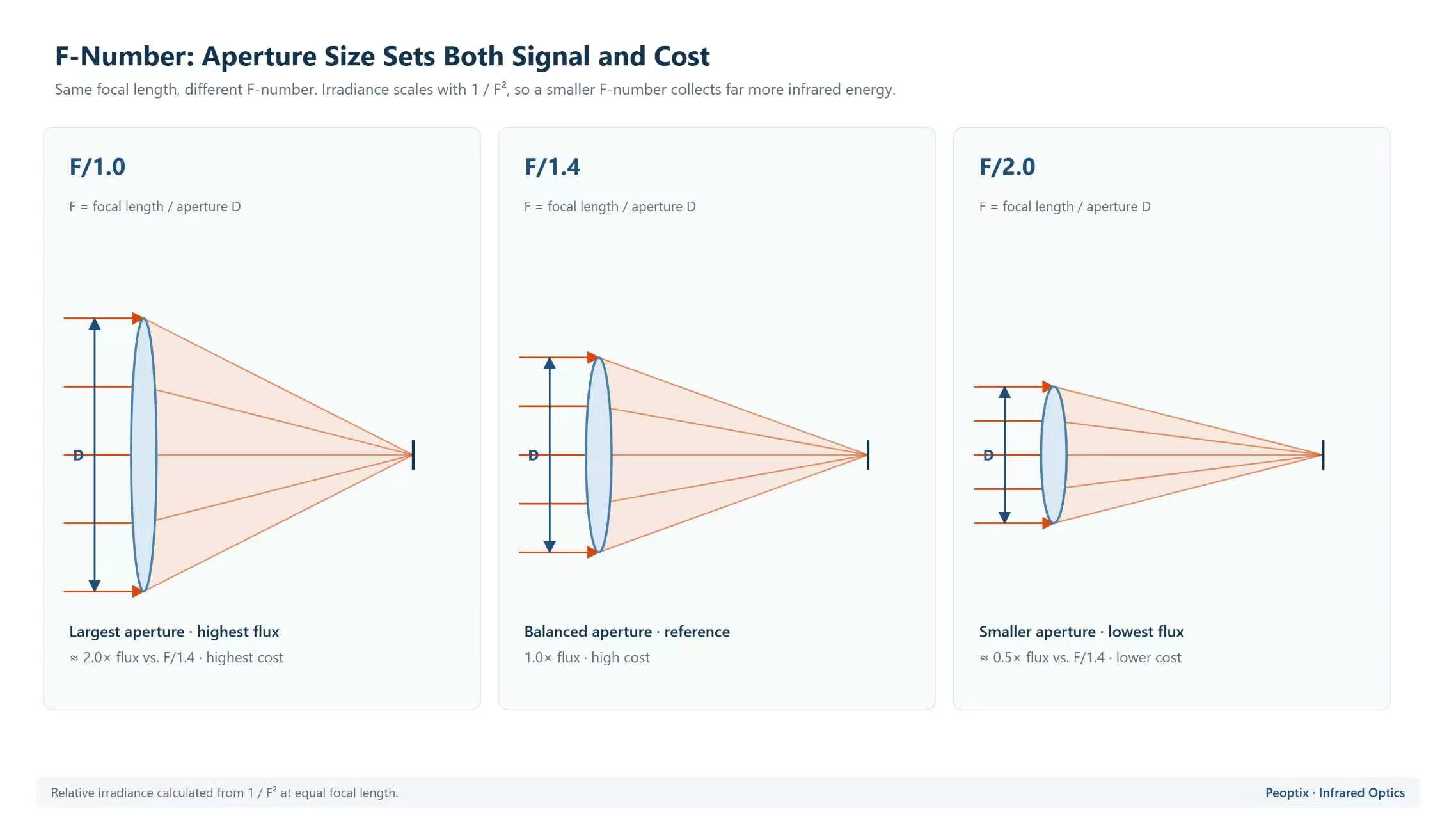
Figure 2. At equal focal length, a smaller F-number means a larger aperture and higher irradiance (1/F²).
2.Aspheric Surfaces: Better Imaging with Fewer Elements
Spherical surfaces are easy to make but leave spherical aberration, coma, astigmatism, field curvature and distortion. Correcting them classically means adding elements — and in the infrared every extra element means expensive material, more coated surfaces, more alignment work and more transmission loss.
A well-designed aspheric surface can replace several spherical elements, cutting parts count, barrel length and weight while raising throughput. The difficulty moves into manufacturing: single-point diamond turning, precision molding, high-accuracy polishing or replication, plus interferometric form measurement and compensating rework. Behind one “complicated curve” stand optical design, ultra-precision machining and metrology together.
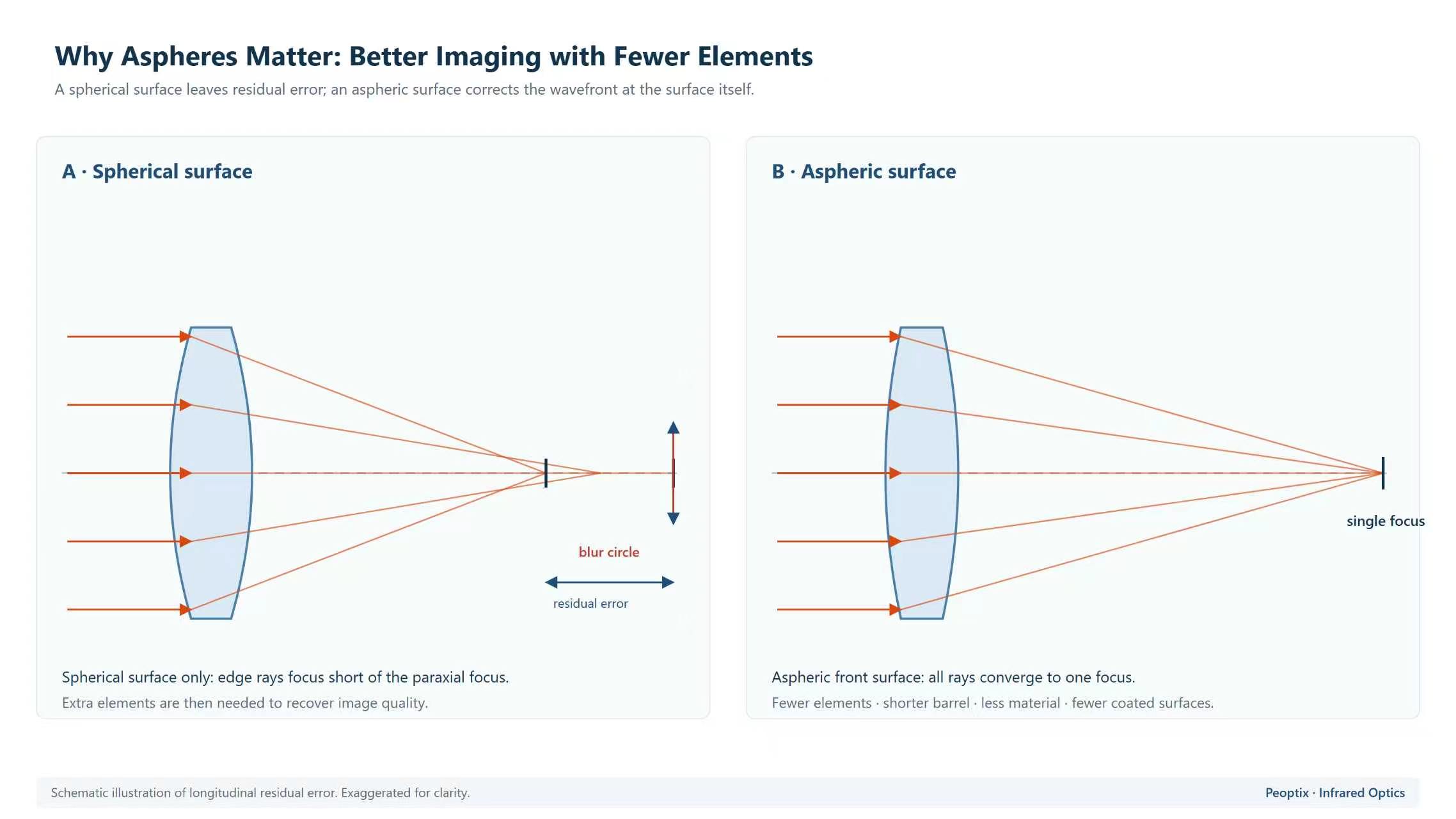
Figure 3. A spherical surface leaves residual error; an aspheric surface converges all rays to one focus.
3. Coatings: The Difference Between 33% and 97%
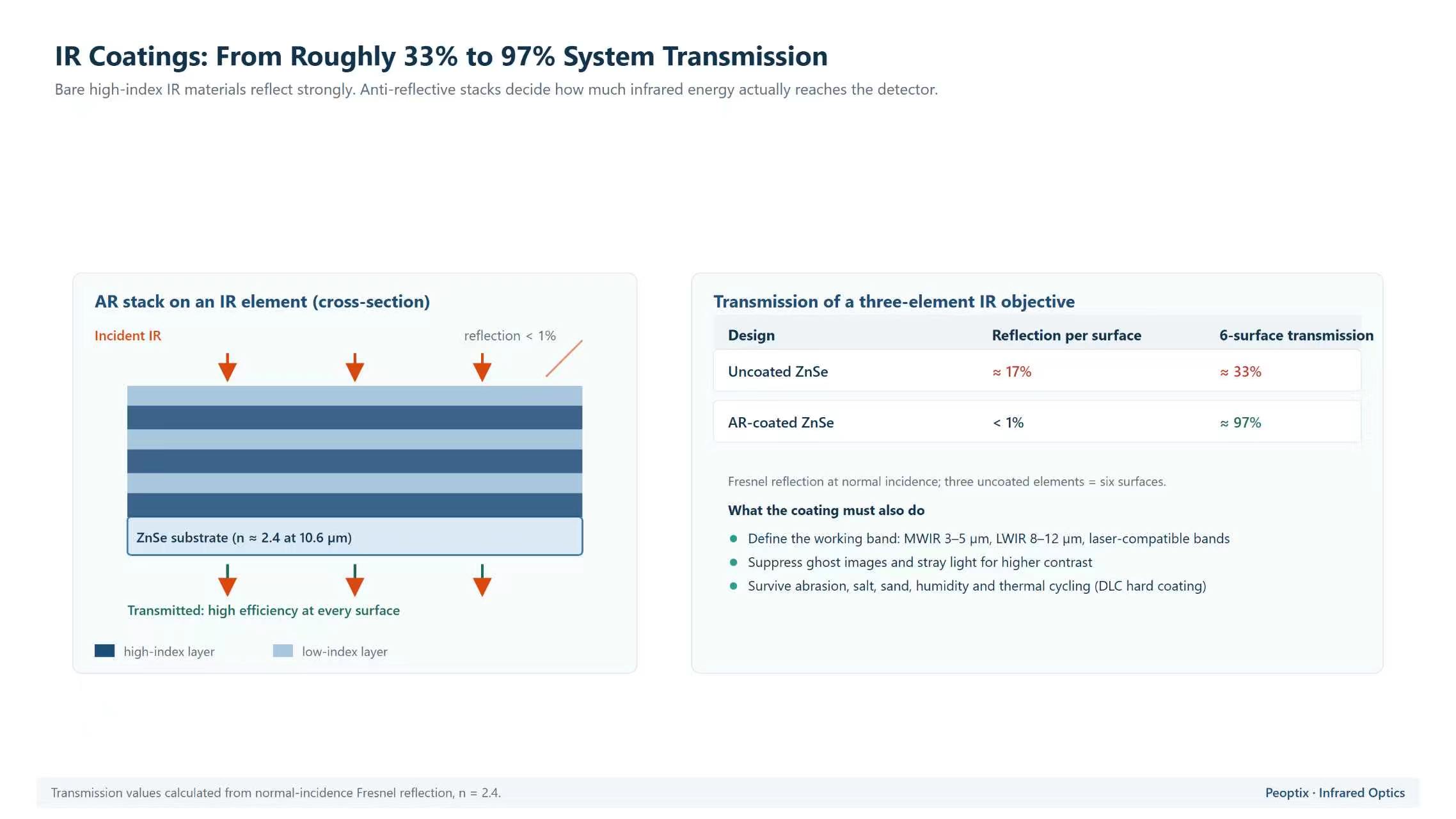
A material that transmits infrared does not transmit it well when bare. Zinc selenide, for instance, has a refractive index near 2.4 at 10.6 µm, so a single uncoated surface reflects about 17%. A three-element objective has six surfaces — barely a third of the incoming energy would survive.
| Design |
Reflection per surface |
Six-surface transmission |
| Uncoated ZnSe |
≈ 17% |
≈ 33% |
| AR-coated ZnSe |
< 1% |
≈ 97% |
Normal-incidence Fresnel reflection; three elements = six surfaces.
Coatings fix this and much more: they define the working band (MWIR 3–5 µm, LWIR 8–12 µm or laser-compatible bands), suppress ghost images and stray light, and shield the front element against abrasion, salt, humidity and sand with a diamond-like carbon (DLC) hard coat. Long wavelengths need thicker, precisely matched layers, and thermal-expansion mismatch can crack a stack. Wideband response, high transmission and durability must be won at the same time.
4. Athermalization: The Hidden Difficulty
Infrared materials change refractive index far more strongly with temperature than visible glasses, and the barrel expands and contracts with heat. The result is focus drift: blurred images, unstable temperature readings and weak small-target detection. Field systems are therefore expected to hold focus from −40 °C to +70 °C — without anyone re-focusing them.
| Approach |
Principle |
Trade-off |
| Optical (passive) |
Materials with complementary thermo-optic response cancel the shift |
No moving parts; limited material choice |
| Mechanical (passive) |
Expansion-matched spacers reposition elements |
No power needed; high mechanical precision |
| Active refocus |
Temperature sensor drives a motor |
Most flexible; adds power, size, failure points |
| Software only |
Digital sharpening |
Partial; cannot recover lost focus |
The Bottom Line
A high-end infrared lens is judged by what it keeps doing in the field — not on a bench at 25 °C: transmitting efficiently, focusing accurately, suppressing stray light and delivering stable, measurable images across the whole temperature range. That is what these four technologies actually buy.

